Prevention as a Service™
Everyone averages glucose. We read its shape.
Endobits forecasts severe glucose events up to 12 hours ahead, ranks a clinic's whole CGM panel by risk, and writes the note and the claim. Live in US clinics and on patients' phones, on Dexcom, Abbott and Senseonics. Revenue-generating. Raising.
In a hurry? The one-page brief (PDF) · name, work email, phone.
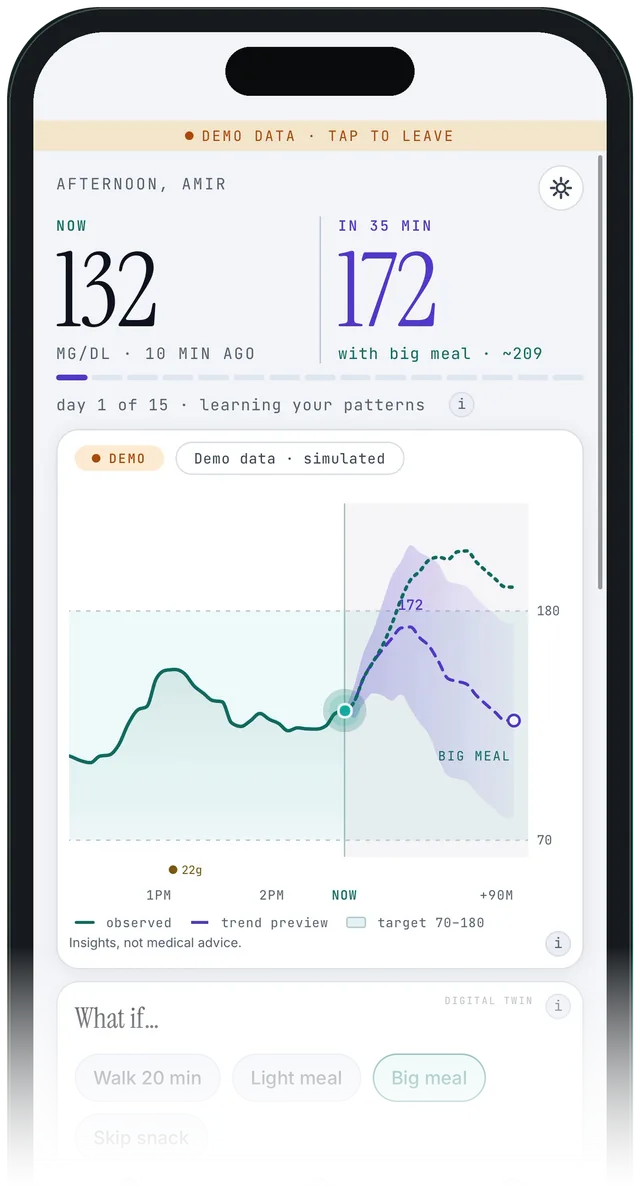
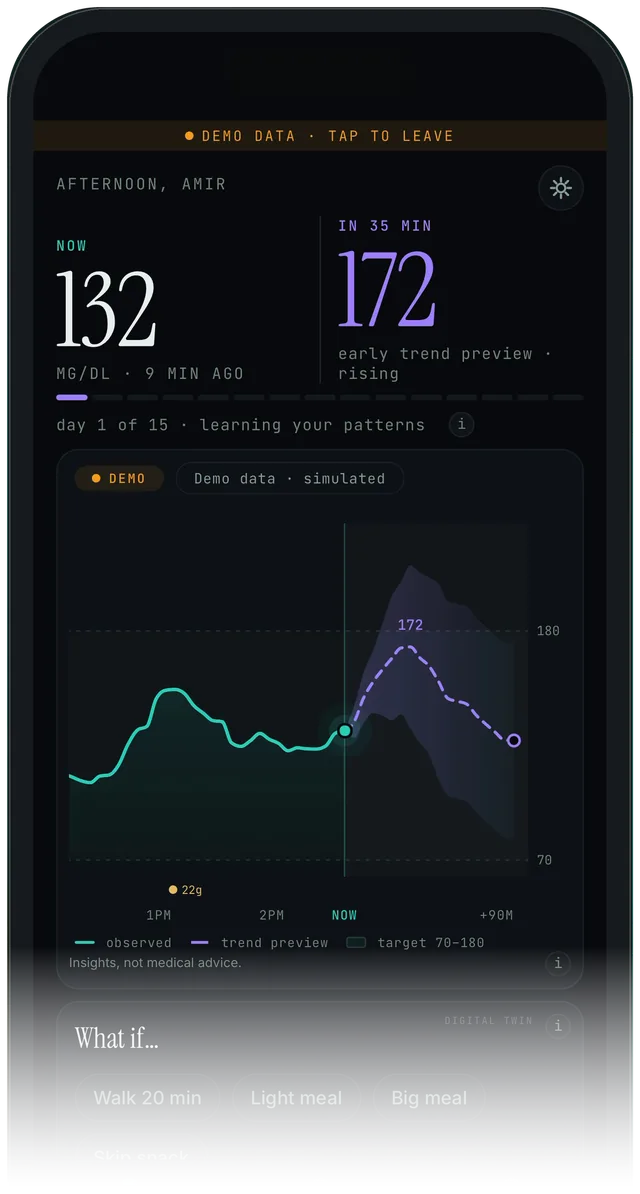
A CGM writes 288 numbers a day. The clinic reads one a quarter.
Clinics were built for twelve fingersticks a month and one HbA1c. The data gets averaged into a lagging number and the shape that predicts complications is thrown away. We keep every reading.
A proper chart review takes a clinician about 30 minutes. Endobits reads a 1,500-patient panel in under a second and says who needs a call tonight.
Highs and lows up to 12 hours ahead, from a per-patient model of how glucose rises, peaks and recovers.
300 CGM patients become a short worklist: tonight, this week, this quarter.
Flag, chart note, Medicare RPM/CCM claim. The clinician acts. Endobits writes.
We charge ~$29 a patient a month. The clinic bills ~$100 to $140 for it.
~$29 / patient / month
$29 primary care, $39.99 endocrinology, from $9.99 per member for payers. Unlimited clinician seats. Only active patients are billed.
~$100 to $140 / patient / month
Medicare RPM + CCM (CPT 99453 to 99458, 99490+), documented by Endobits. Roughly 4× what they pay us, with clinician time per patient down from ~30 minutes to ~3.
48% fewer severe lows*
+10% time in range and a warning hours before trouble, from the phone in their pocket.
Software only, sensor-agnostic, no hardware. Revenue scales with the panel, not the sales call. Prediction is a retention engine for device makers and a phenotyping layer for GLP-1 prescribing. We do not sell patient data. ARR and customer count: in the data room.
~10M US CGM wearers today. 97.6M prediabetic adults behind them, now reachable over the counter.
The wedge alone carries the business. Payers, pharma and longevity run on the same engine, unchanged.
95.7% in live clinics. Above 90% on the noisiest external registries.
Eight studies, six shown. Peer-reviewed in JMIR Diabetes, verified by the National Research Council of Canada. The technical risk is behind us.
| Study | Patients | Data points | Result |
|---|---|---|---|
| Real-world, live clinical | 142 | 10.4M | 95.7% accuracy · +10% time in range |
| Real-world 1h forecasts vs ADA ranges | 100 | 7.7M | 94.4% · 85.7 / 96.6 sens / spec |
| OhioT1DM public benchmark | 12 | 401,916 | 93.6% · 83.6 / 96.1 sens / spec |
| External registries (Weinstock + Chase) | 400 | 11.2M | ~90% held on the noisiest cohorts, ages 7 to 80 |
| BC Children's Hospital · blind | 8 | 0.17M | 94.9% pediatric accuracy |
| JMIR peer-reviewed · 280 users | 280 | 6.9M | 99.6% of forecasts clinically acceptable |
Models commoditize. Outcomes data, reimbursement and regulatory position compound.
They sell sensors. We read the curve.
Endobits runs on Dexcom, Abbott and Senseonics, and the reason to keep wearing a sensor belongs to whoever reads the curve best. Patented on the method: glucotype classification and intervention pathways. Software, not silicon.
A retention engine for the sensor. Investment, distribution partnership, or both.
Four patented glucotypes from two weeks of ordinary CGM data, for GLP-1 precision prescribing.
A generalist model without ground truth is a chart reader that does not know what happened next. Endobits V5 already runs GPT-4 on top of our engine.
Two people can share an HbA1c and a time-in-range and be on different paths. Endobits models the curve's morphology, rise, peak, recovery and night, and clusters it into four glucotypes from two weeks of everyday CGM data, no tolerance test. The same signature maps onto the twelve hallmarks of aging: the next product, not this round. The full science →
Everyone charts. Endobits predicts, triages and bills.
| Endobits | Dexcom-native | Glooko | Sugarmate | LLM generalists | |
|---|---|---|---|---|---|
| Forecast horizon | 1 to 12h | ~30 min | None | ~30 min | Not validated |
| Panel triage by risk | Yes | No | Partial | No | No |
| Glucotyping / dysglycemia | Yes · patented | No | No | No | No |
| Sensor-agnostic | Dexcom · Abbott · Senseonics | Dexcom only | Yes | Dexcom | n/a |
| Billing automation (RPM/CCM) | Built in | No | Partial | No | No |
| Clinical validation | 8 studies · NRC verified | Device-level | Reporting | No | No |
As publicly documented at time of writing.
Regulatory. Non-device clinical decision support under FDA's CDS guidance, revised January 2026: transparent logic, the clinician makes the call. HIPAA-compliant, on FDA-cleared CGMs. Features that act without a clinician go through a scoped 510(k) / De Novo path; predicate and pre-sub strategy in the data room.
CGM went mass-market. Reimbursement moved upstream. FDA drew the line for software. The science caught up.
Dexcom Stelo and Abbott Lingo cleared OTC in 2024. 97.6M prediabetic adults addressable without a prescription.
Medicare RPM (CPT 99453 to 99458, 99091) and CCM (99490+) pay clinics to watch the data today.
FDA's CDS guidance, revised January 2026, keeps clinician-in-the-loop software outside device regulation. Endobits is built on that line.
Lancet Diabetes & Endocrinology (2025) calls for staging prediabetes and type 2 diabetes by CGM-derived metrics. That is the layer Endobits reads.
Distribution rides the sensor (Dexcom, Abbott, Senseonics), the chart (eClinicalWorks, Oracle Health Cerner, Athenahealth, OSCAR, Cliniko) and the $1.5M PacifiCan hospital roll-out across Canada and the US.
Founded in Vancouver out of a BC Children's Hospital study: blind pediatric validation, 94.9%.
Diabits, the consumer glucose-prediction app. ADA 79th poster.
Endobits launches, clinician-first.
Peer-reviewed in JMIR Diabetes; ADA 80th, 81st and 82nd.
Dexcom, Abbott and Senseonics support; GPT-4 inside Endobits V5.
$1.5M Government of Canada. Virtual Clinic open to patients (September). Android app (October).
Series A, open now. Capital gated to proof.
The engine is built, validated and in market. This round answers one question: does dysglycemia detection generalize across every population? It funds the studies that prove it, and the second tranche releases only when the Year-1 proof lands.
Talent first, studies next.
A decade and $8M+ in. The hard part is built; the round buys capacity, not foundations.
Founded Bio-Conscious in 2016 out of a BC Children's Hospital study. A decade on this problem, from the Diabits consumer app to Endobits in US clinics. LinkedIn →
Board-certified endocrinologist with about 40 years in clinical diabetes care. Leads study design, clinical validation and the clinician-in-the-loop product line. Profile →
About 20 years building clinical-grade platforms: sensor integrations, EHR channels, the forecasting engine and the apps in both stores. Bios, advisors and board in the data room.
Seen the numbers? Let's talk.
Twenty minutes with the founder, or the full data room within one business day.
Request the data room.
One business day to a link. Inside: the deck, the financial model with three scenarios, round terms and tranche milestones, study reports and the NRC verification, patents, the named pipeline, team bios, advisors and board, quality-system and regulatory milestones.
Not now? The monthly investor update is five lines, once a month. Tick the box.
* Clinic-reported figures; supporting data in the data room.
Wear it before you fund it. Try a CGM today.
Order a sensor from us, put the app on your phone and watch your own curve for two weeks before we talk. Or open the app and tap Explore the demo to look around first.