Your glucose metabolism tells a story. Hear it before a diagnosis does.
We help you read the story in your glucose long before a diagnosis does, so problems can be caught and prevented while there is still time to change them.
No CGM? Get your first CGM here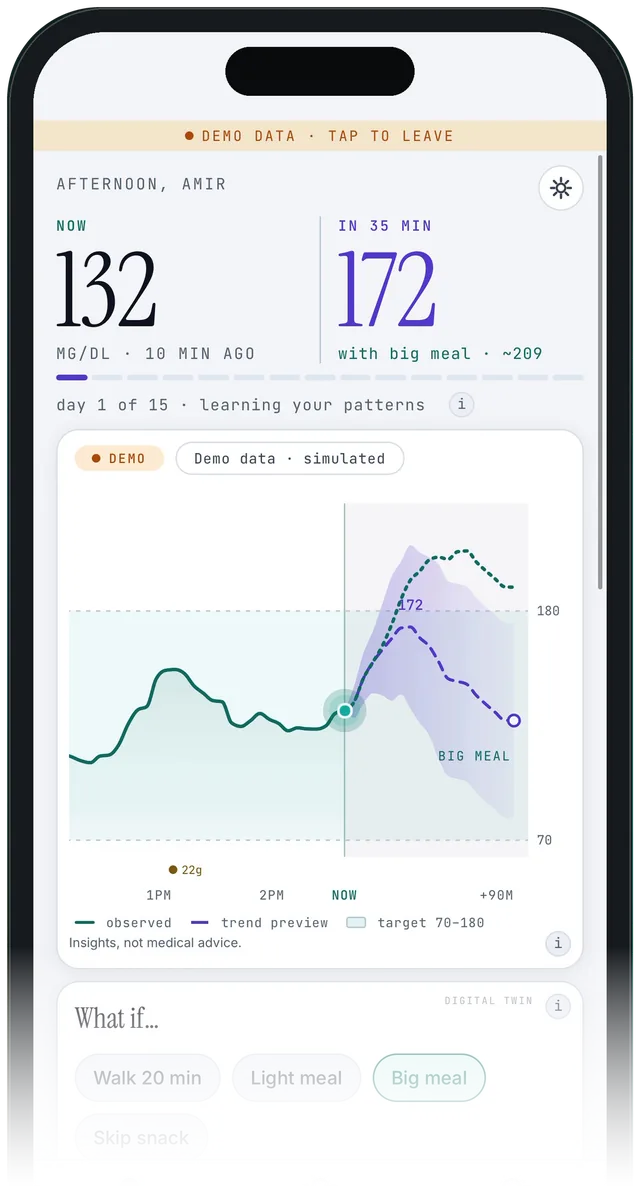
HbA1c is a rear-view mirror. The risk is in your glucose curves.
And it's the only metabolic factor most doctors are looking at. It's an average that only sees the past, and it hides the glucose swings that quietly do the damage.
One HbA1c score can belong to three very different people, and your doctor is left to decipher which one you are. The average hides it; the shape reveals it.
Three simple steps. Start on your phone.






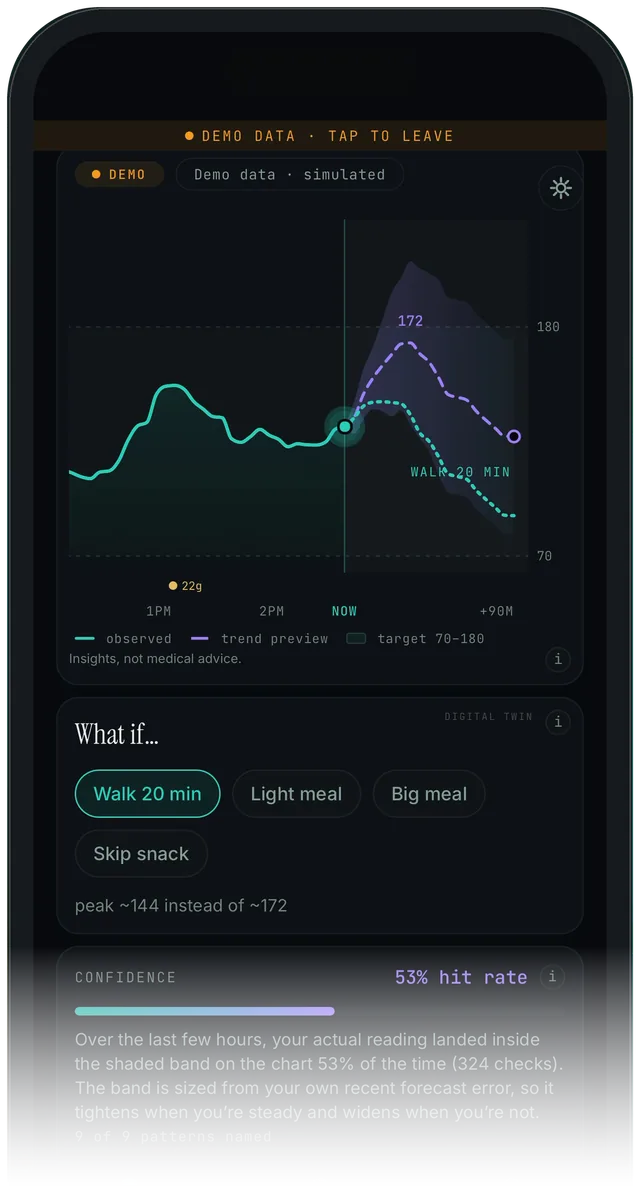
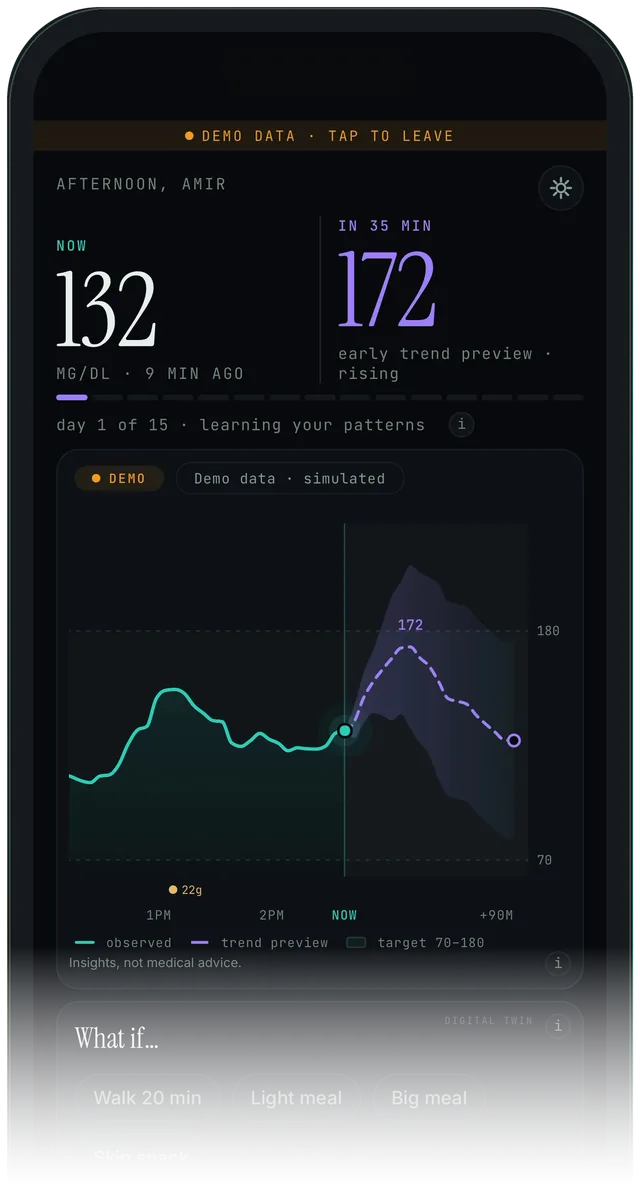
Free on iPhone and Android.
Your curves, your forecasts, and Nora, in one place.
For the first time, you can read your own glucose. Most people never do.
Sensors that used to need a prescription are now on pharmacy shelves. The data is there. What has been missing is something that reads it for you, and tells you what to do before it becomes a diagnosis.
The blood test says normal until it doesn’t. The curve shifts years earlier.
A sensor is now as easy to get as a fitness tracker. Endobits reads all the major ones.
A walk after dinner, a swapped breakfast, and above all a good night's sleep: one poor night raises tomorrow's glucose, and you see the curve respond within hours, not at next year's blood test.
Nine years of R&D, built for clinics. Now available to you.
The same intelligence hospitals and endocrinology clinics run on, now on your phone. Nothing to buy, nothing to install: it reads the sensor you already wear.
Dexcom, Stelo, Abbott Libre and Lingo, Senseonics Eversense, read through Apple Health on iPhone, Health Connect or a direct Dexcom link on Android. Switch sensors and your history comes with you.
eClinicalWorks, Cerner, Athenahealth, OSCAR and Cliniko. If your clinic runs Endobits, your trends reach your doctor between visits with an invite code.
When your clinic monitors you with Endobits, the monitoring is billed to Medicare or your insurer under remote-monitoring codes. The Companion app itself is free.
Your glucose curve is a window on how fast you are aging.
Scientists describe twelve ways the body ages. Sugar swings speed up every one of them, and a steady curve slows them down. Think of it as a body clock: tap any hour.
Your glucotype, your curve, and what it says about each of the twelve hallmarks, in plain language.
Educational only. Endobits does not diagnose or measure biological age; it reads glucose patterns that research links to these processes.
Framework: López-Otín et al., Hallmarks of aging: an expanding universe, Cell (2023). Plain-language guides, calculators and the evidence behind each link: endobits.com/resources.
Questions, answered.
No. Many members are simply concerned about their blood sugar or have prediabetes in the family. A clinician reviews your case when you sign up.
If you already wear a CGM, the Endobits Companion app reads it through Apple Health on iPhone, or Health Connect and a direct Dexcom link on Android. If not, the Virtual Clinic can help you get one.
Your glucose in plain language, a heads-up when a high or low is coming, and simple suggestions you can act on. No charts to decode.
Licensed clinicians at the Endobits Virtual Clinic. If something needs attention, they reach out to you.
Yes. Endobits is HIPAA-compliant. Your data is used to care for you, never sold.
Bio-Conscious Technologies Inc. is a Vancouver-based company building predictive metabolic AI. Its platform, Endobits, reads continuous glucose monitoring (CGM) data to help predict, prioritize and prevent metabolic disease.
Typical apps display the reading after the fact. Endobits forecasts forward, clusters patients into distinct glucotypes, and ties the glucose signal to clinical-outcome labels, turning data into action.
A glucotype is a distinct metabolic phenotype derived from the shape of a person's glucose curve rather than an average, letting care be personalized to how an individual's glucose actually behaves.
Bio-Conscious Technologies Inc. is headquartered in Vancouver, BC, Canada.
“The body consumes calories. The mind consumes ideas. Feed both deliberately.”
Amir Hayeri, Founder, Bio-Conscious Technologies
See complications before symptoms. Get paid to prevent them.
Endobits ranks your CGM panel by forecast risk, flags patients before they crash, and documents billable RPM/CCM work automatically. +250% clinical revenue, 48% fewer severe hypos.*
Pricing, performance data, the product demo and onboarding for primary care, endocrinology and payers all live there.
Open Endobits→Unlimited clinician seats. First 25 patients free. Endocrinology tier at $39.99.
8 independent studies, verified by the National Research Council of Canada.
Interactive simulator running the latest release, Version 5.
Primary care, endocrinology and payer pages with time-saved and impact estimators.
See complications hours ahead.
“Calories shape the body. Information shapes the mind. Feed both deliberately.”
Amir Hayeri, Founder, Bio-Conscious Technologies
Glucose is the 5th vital sign. CGMs measure it. Endobits acts on it.
A decade of novel research, now at scale: Prevention as a Service™. Endobits predicts metabolic complications and helps clinicians prevent them. Eight independent studies, 70M+ real-world glucose values, 95.7% forecast accuracy in live clinics. A category we own. Others will follow. Clinical performance →
Everyone averages glucose. We read its shape to predict, prioritize and prevent metabolic complications.
Clinical decision support on top of every major CGM, EMR and EHR. Live in US clinics; live for patients through the Endobits Virtual Clinic since September 2026.
Clinics and plans pay a flat monthly fee per monitored patient. They bill Medicare several times that for the monitoring Endobits makes possible. See the formula ↓
Nine years of R&D, a $1.5M Government of Canada investment, and a hospital roll-out under way. Round details in the investor brief.
Clinicians are drowning in glucose data. No one has time to read it. We read it so they don't have to.
A CGM produces 288 readings a day, over 100,000 a year per patient. Clinics were built for twelve fingersticks a month and one HbA1c a quarter, so the data gets averaged into a single lagging number and the granularity that predicts complications is thrown away. We keep every reading.
The result: 97.6M US adults with prediabetes, 8 in 10 unaware, and $413B a year in diabetes cost, a quarter of it lost productivity (CDC; ADA 2022).
Between the sensor and the physician, Endobits gives clinicians superpowers: predict, prioritize and prevent beyond what is humanly possible.
A proper CGM chart review takes a trained clinician up to 45 minutes. Endobits reads an entire panel in under a second, forecasts each patient hours ahead, and floats the ones who need a specialist to the top. No new hires; the team works at the top of its license.
A per-patient model learns how their glucose rises, peaks and recovers, then projects the curve forward while there is still time to act.
A clinic of 300 CGM patients becomes a short worklist: who is heading for trouble tonight, this week, this quarter.
The clinician acts on the flag; Endobits writes the note and captures the Medicare RPM/CCM work. Prevention pays for itself.
Ranks the CGM panel by forecast risk, flags the low before it lands, and bills the visit. +250% clinical revenue.
Your glucose now, and where it is heading. Learns your body in 14 days, on your phone. Free.
CGM went mass-market. Reimbursement moved upstream. FDA drew the line for software.
Dexcom Stelo and Abbott Lingo cleared OTC in 2024. The sensor is now a pharmacy purchase; 97.6M prediabetic adults just became addressable without a prescription.
Medicare RPM (CPT 99453–99458, 99091) and CCM (99490+) reimburse remote monitoring today. Clinics are paid to watch the data; they need something that reads it.
The 2022 final guidance defines non-device clinical decision support: transparent, clinician-in-the-loop software. Endobits is built on that line, with a mapped path beyond it.
And the science caught up: Lancet D&E (2025) now calls for prediabetes and T2D to be staged by CGM-derived metrics, the exact data layer Endobits reads.
See complications hours ahead.
Nine years of research, now in market.
Above 90% accuracy out to hour 11. Every cohort independent.
Three concatenated deep-learning layers, each harder to replicate than the last.
Our defensibility is a whole stack, not a single model. Each layer builds on a proprietary understanding of glucose metabolism, compounding into an early-detection engine that extends far beyond diabetes.
Each level requires the one below it. Two granted patents. One pending.
70M+ glucose values across 3,000+ participants, labelled with what happened next, accumulated over nine years and across Dexcom, Abbott and Senseonics. Four glucotypes read from everyday CGM, no tolerance test. Two granted patents (glucotype classification, intervention pathways), one pending (Glucose Atlas). A fast follower can buy compute; it cannot buy nine years of outcomes.
Tap a hallmark. Each is wired to glucose metabolism, and each is something only the shape of the curve can reveal early.
High glucose activates NF-κB and inflammatory cytokines, the “inflammaging” engine behind most age-related disease.
Level 3 lens · Glycemic instability tracks tightly with metabolic inflammation.
Non-device CDS today. A mapped path for what comes next.
Levels 1–3 operate as clinician-facing decision support under FDA’s 2022 CDS guidance: transparent logic, clinician makes the call. HIPAA-compliant; runs on FDA-cleared CGMs.
Level 4 features that act without a clinician in the loop (autonomous alerts, closed recommendations) go through a device pathway. Predicate and pre-sub strategy scoped.
Quality-system status: detailed in the investor brief.
Pre-sub, submission and clearance milestones: detailed in the investor brief.
Everyone in the chain comes out ahead. That is the whole model.
Simple, per-patient, per-month software. The clinic bills the payer for monitoring it could not do before; the payer avoids the complication; the patient stays out of the ER. We take a small, predictable slice.
Read every CGM on the panel, forecast up to 12h ahead, rank by risk, and write the RPM/CCM record automatically.
$29 primary care, $39.99 endocrinology, from $9.99 per member for payers. Unlimited clinician seats. Only active patients are billed.
Medicare RPM + CCM (CPT 99453–99458, 99490+) reimbursed per patient per month. Roughly 4× what they pay us, with clinician time per patient down from ~30 minutes to ~3.
48% fewer severe lows,* +10% time in range, a heads-up hours before trouble, all from the phone in your pocket. Often at $0, sponsored by the clinic or plan.
Software only, no hardware, sensor-agnostic. Every new patient on the panel is billable to the clinic and monthly to us; one clinic carries a larger reimbursable panel with the same staff.
Outcome-linked pricing against avoided complications, plus HEDIS and Star levers. A single avoided admission covers years of subscriptions. We do not sell patient data.
Prediction as a retention engine for device makers; glucotype phenotyping for GLP-1 precision prescribing. Partnership revenue on top of the subscription base.
CGM users × price. No $100B slide.
Installed base across Dexcom and Abbott, growing ~20% a year before the OTC wave. Every one produces 288 readings a day.
Provider price. 10M × $29 × 12 ≈ $3.5B annual software revenue at full coverage; a 10% share of CGM wearers in RPM programs is ~$350M ARR.
US adults with prediabetes now reachable with an OTC sensor; payers price at $9.99 per member per month.
Assumptions are ours and stated; the point is that the wedge market alone supports the business before longevity, payers or pharma enter the model.
Ride the sensor, the EHR and the hospital. Named, not hoped.
Compatible with all three, including the only implantable CGM. Distribution rides the sensor.
Inside the chart, not beside it. No rip-and-replace.
$1.5M Government of Canada investment to bring Endobits to hospitals across Canada and the US.
Health systems, payers and pharma in active discussion: listed in the investor brief.
Everyone charts. Endobits predicts, triages and bills.
Competitor capabilities as publicly documented at time of writing; corrections welcome.
Questions, answered.
Clinical decision support for CGM: automated remote monitoring, risk stratification and documentation for clinics, plus the Endobits Virtual Clinic for patients. Decision support, not a medical device.
Severe hypo- and hyperglycemic events up to 12 hours ahead, under physician supervision. Longer-term, glucotypes indicate underlying conditions across months and years.
The Endobits Companion app reads Dexcom, Abbott FreeStyle Libre and Senseonics Eversense (the only implantable CGM) through Apple Health on iPhone. On Android it reads Dexcom G6, Stelo and Lingo through Health Connect, or Dexcom directly for US accounts; Eversense on Android is coming soon. Endobits for clinics is sensor-agnostic.
Yes, within Medicare RPM and CCM frameworks (CPT 99453, 99454, 99457, 99458), so clinics capture value from data they already collect. Coverage varies by payer.
Launched September 2026: patients get immediate decision support and clinician-backed monitoring outside the clinic, on their phone.
“The body runs on calories. The mind runs on information. We are building the layer that makes both count.”
Amir Hayeri, Founder, Bio-Conscious Technologies
now available
Endobits Companion is now available on Android.
The free Endobits Companion app shows your glucose now and where it is heading. Download it on Google Play or the App Store and start reading your curve today.